The Dragon's Code: How Chinese Open Source AI Models Are Rewriting Silicon Valley's Monopoly
In the gleaming towers of Silicon Valley, where algorithms are treated like state secrets and profit margins dictate progress, a quiet revolution has been brewing across the Pacific. For years, the narrative remained unchanged: American tech giants—OpenAI, Google, Anthropic—held the keys to artificial intelligence's kingdom, their closed-source models locked behind proprietary walls and subscription paychecks. But in 2025, that narrative is crumbling faster than a deprecated code base.
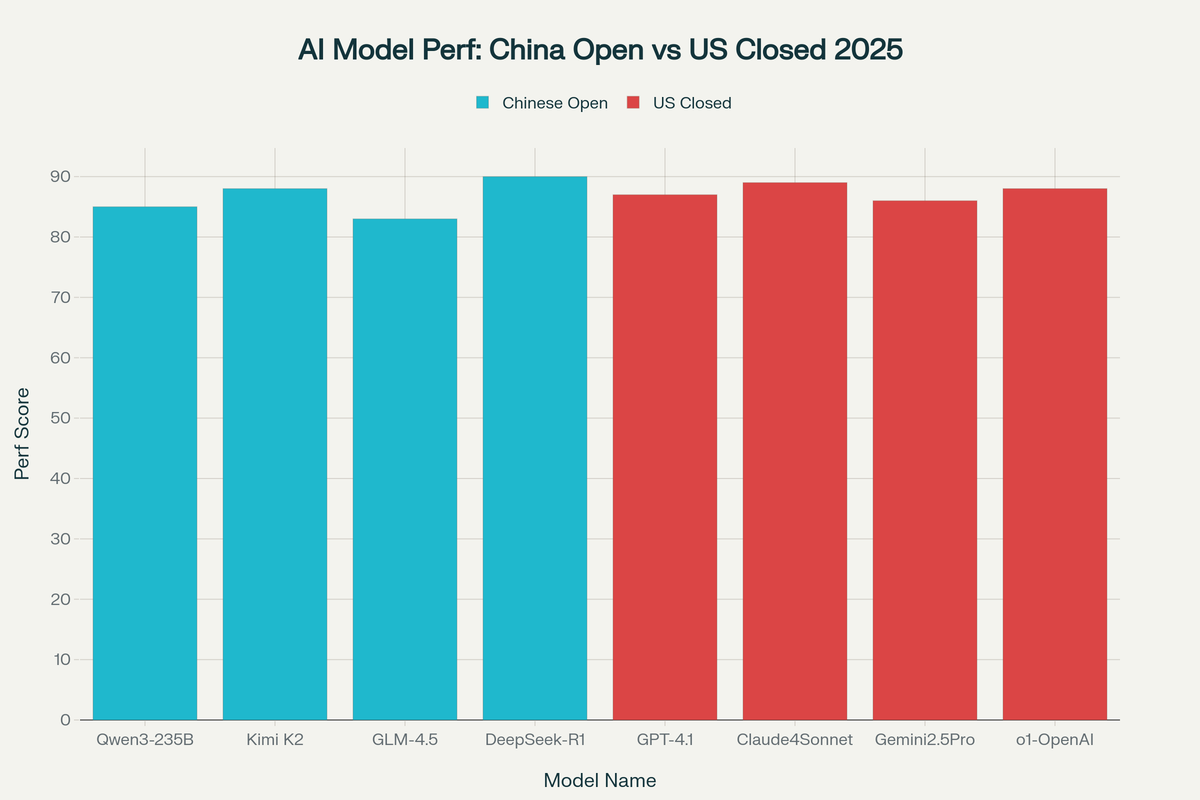
Competition Between Chinese Open Source and US Closed Source AI Models (2025)
The disruption didn't arrive with fanfare or IPO bells. Instead, it came wrapped in Apache 2.0 licenses and MIT permissions, carrying names like Qwen3, Kimi K2, GLM-4.5, and DeepSeek-R1[1][2][3][4]. These Chinese-developed models aren't just competitive alternatives—they're existential threats to Silicon Valley's business model, built on the radical premise that the world's most powerful AI should be free, transparent, and accessible to anyone with a computer and an internet connection.
The Unlikely David Against Silicon Valley's Goliaths
DeepSeek's R1 model epitomizes this paradigm shift. Released in January 2025 under an MIT license, it matches OpenAI's flagship o1 model across mathematics, coding, and reasoning tasks[4:1][5]. The kicker? It cost just $5.6 million to train—pocket change compared to the hundreds of millions American companies pour into their black-box models[4:2][6]. When DeepSeek's capabilities became public, Nvidia lost nearly $600 billion in market value in a single day, the largest single-day loss in corporate history[7][8].
The technical achievements are staggering. Alibaba's Qwen3-235B, despite its mixture-of-experts architecture activating only 22 billion of its 235 billion parameters, rivals GPT-4 and Gemini 2.5 Pro while supporting 119 languages and dialects[1:1][9]. Moonshot AI's Kimi K2, with its 1 trillion total parameters and specialized agentic capabilities, outperforms GPT-4.1 on coding benchmarks while maintaining the ability to orchestrate complex multi-step workflows[2:1][10]. Zhipu AI's GLM-4.5 ranks third globally among all models and second among open-source alternatives, demonstrating that transparency doesn't require sacrificing performance[11][12].
These aren't incremental improvements—they represent a fundamental reimagining of how AI should be developed and distributed. While American companies guard their training data and methodologies like nuclear launch codes, Chinese researchers are publishing detailed technical papers, releasing model weights, and inviting the global community to build upon their work.
The Philosophy of Openness Versus the Pursuit of Profit
The divergence between these approaches reflects deeper philosophical differences about AI's role in society. OpenAI, despite its name, has steadily retreated from its founding mission. Originally established as a nonprofit in 2015 with the explicit goal of developing "safe AGI that is broadly beneficial," the organization has morphed into something unrecognizable[13][14]. Its complex corporate structure—a nonprofit parent controlling a for-profit subsidiary—has become increasingly strained as billions in investment demand returns[13:1][15].
The irony is palpable. OpenAI, whose very name promised openness, now refuses to disclose even basic details about GPT-4's architecture, training data, or methodologies[16]. When critics began calling it "ClosedAI," the company's response wasn't greater transparency—it was better public relations. Meanwhile, Chinese labs are releasing not just model weights but comprehensive documentation, training techniques, and reproducible research.
This shift toward secrecy isn't accidental—it's structural. OpenAI's transition from nonprofit to "capped-profit" to its current form reflects the fundamental tension between serving humanity and serving shareholders[13:2][15:1]. Recent reports suggest the company is preparing to shed its nonprofit oversight entirely, fully embracing a for-profit structure that prioritizes investor returns over public benefit[17][18]. CEO Sam Altman, who once proclaimed that artificial general intelligence "really does deserve to belong to the world as a whole," now oversees a company valued at $300 billion that charges users for access to intelligence that was supposed to be freely available[14:1].
The corporate structure itself reveals the problem. OpenAI's for-profit subsidiary operates under a "capped-profit" model that theoretically limits investor returns to 100 times their investment[15:2][19]. But as the company's valuation soars and pressure mounts to deliver returns, these caps become increasingly meaningless. The nonprofit board that was supposed to ensure the mission came first has been gradually weakened, its independence compromised by conflicts of interest and commercial pressures.
Open Source Versus Open Weights: Understanding the Distinction
The Chinese approach highlights a crucial distinction often overlooked in AI discussions: the difference between open source and open weights[20][21]. Most AI models claiming to be "open source"—including many Chinese offerings—are more accurately described as "open weights." They release the trained parameters that allow the model to function but withhold the training data, algorithms, and methodologies used to create those parameters.
True open source AI, as defined by the Open Source Initiative, requires releasing all components: training data, code, parameters, and documentation sufficient for reproduction[20:1][22]. By this standard, few models qualify as genuinely open source. Even DeepSeek's R1, despite its MIT license and impressive transparency, doesn't release its complete training dataset.
However, open weights still represent a massive improvement over closed-source models. Users can inspect model behavior, fine-tune for specific applications, and run models locally without sending data to external servers[20:2][23]. This transparency enables bias detection, security auditing, and customization impossible with closed systems. Most importantly, it prevents vendor lock-in and ensures that technological progress benefits the broader community rather than enriching a few corporations.
The Competitive Pressure That Forced OpenAI's Hand
The success of Chinese open models has created an uncomfortable reality for Silicon Valley: they can no longer assume their closed-source approach guarantees competitive advantage. The evidence suggests this pressure is already forcing changes. OpenAI's recent testing of "Horizon Alpha"—rumored to be a 120 billion parameter mixture-of-experts model available through OpenRouter—represents a potential shift toward more open offerings[24][25][26].
Multiple sources suggest Horizon Alpha could be OpenAI's planned open-source model, released in response to Chinese competition[24:1][25:1][27]. The model's impressive performance in early testing, particularly for coding tasks, indicates OpenAI recognizes it must offer something beyond proprietary access to remain competitive. The timing isn't coincidental—it comes as Chinese models demonstrate that open development can match or exceed closed alternatives.
This represents a fundamental shift in AI strategy. For years, OpenAI's competitive moat was its technological lead and exclusive access model. Users paid premium prices because they had no alternatives. Chinese open models have shattered this monopoly, proving that excellent AI doesn't require exclusive access or subscription fees. If users can achieve similar results with free, customizable models, why pay for closed systems?
The broader implications extend beyond any single company. The entire Silicon Valley model—proprietary development, venture capital scaling, winner-take-all competition—faces challenges from distributed, open development communities. Chinese researchers have shown that collaborative development can iterate faster and produce superior results than closed corporate labs.
The Innovation Acceleration Effect
Open source development has historically accelerated innovation across technology sectors[23:1][28]. Linux challenged Microsoft's Windows monopoly, Apache displaced proprietary web servers, and Android created viable competition to iOS. In each case, open development models enabled faster iteration, broader participation, and superior outcomes than closed alternatives could achieve.
AI appears to follow this pattern. When model weights are freely available, researchers worldwide can experiment, improve, and build upon existing work[23:2][29]. Instead of each organization starting from scratch, the community builds collectively on shared foundations. This collaborative approach has produced remarkable results: DeepSeek's distillation techniques, Qwen's multilingual capabilities, and GLM's dual reasoning modes all emerged from open research that competitors can study and improve upon.
The speed of innovation in open AI models has been breathtaking. DeepSeek matched OpenAI's latest reasoning model within months of its release[4:3][6:1]. Chinese researchers routinely publish techniques that Western companies then incorporate into their own systems. This reversal of traditional technology transfer—from East to West—represents a fundamental shift in global AI leadership.
More importantly, open development democratizes access to cutting-edge AI capabilities[23:3][29:1]. Startups, researchers, and developers worldwide can access state-of-the-art models without paying enterprise licensing fees or navigating complex corporate partnerships. This accessibility enables innovation that closed systems would stifle—small companies building specialized applications, researchers investigating AI behavior, and developers creating tools that serve underrepresented communities.
The Geopolitical Dimension
The rise of Chinese open source AI models carries profound geopolitical implications. For decades, American technological dominance rested on controlling key innovations and standard-setting. Silicon Valley companies didn't just build better products—they shaped entire industries around their technologies and business models.
Chinese open models threaten this dominance by offering credible alternatives that don't require dependence on American companies[30][31]. Countries concerned about technological sovereignty can build their AI capabilities on open Chinese models rather than subscribing to American services. This shift could reshape global technology alliances and reduce American soft power projection through technology platforms.
The timing coincides with increasing U.S. restrictions on AI technology exports to China[4:4][7:1]. American policymakers hoped semiconductor export controls would slow Chinese AI development. Instead, Chinese researchers responded by creating more efficient models that require less computational power while matching or exceeding American performance. This efficiency innovation may prove more valuable than raw computational scaling.
The success also challenges assumptions about innovation models. American venture capital and corporate research prioritize proprietary advantages and market capture. Chinese researchers, operating under different incentives, have chosen collaborative development that shares advances freely. The superior results from this approach suggest that American innovation models may be suboptimal for AI development.
Why Open Source Matters for Humanity's Future
The philosophical differences between open and closed AI development reflect deeper questions about who controls humanity's technological future. AI systems increasingly mediate human knowledge, decision-making, and social interaction. The principles governing their development will shape civilization for generations.
Closed-source AI concentrates power in the hands of a few corporations and their investors[23:4][32]. These entities make unilateral decisions about AI capabilities, safety measures, and access policies. Users must trust corporate assurances about bias, security, and alignment without independent verification. When problems arise—and they inevitably do—fixes depend on corporate priorities rather than community needs.
Open source AI distributes this power across a global community of researchers, developers, and users[23:5][29:2]. Problems can be identified and addressed by anyone with relevant expertise. Improvements benefit everyone rather than enriching shareholders. Most importantly, no single entity can unilaterally decide how these powerful technologies evolve.
The stakes extend beyond technical considerations. AI systems encode the values, biases, and priorities of their creators. Closed systems embed the worldviews of Silicon Valley executives and their investors—predominantly wealthy, white, male Americans with specific cultural and economic perspectives. Open systems enable diverse global communities to shape AI development according to their own values and needs.
Chinese open models don't automatically solve these problems—they carry their own cultural biases and limitations. However, their existence creates competition between different approaches and philosophies. Users can choose systems that align with their values rather than accepting whatever closed-source providers offer.
The Economic Reality Check
The economic arguments for closed-source AI are becoming increasingly difficult to defend. Proponents claim that proprietary development is necessary to recoup massive investment costs and fund continued research. But Chinese models demonstrate that excellent AI can be developed for a fraction of Silicon Valley's spending[4:5][6:2][7:2].
DeepSeek's $5.6 million training cost for R1 contrasts sharply with reports of hundreds of millions spent on comparable American models[4:6]. Even accounting for potential hidden costs or subsidies, the efficiency gap is enormous. Chinese researchers have achieved superior results through algorithmic innovations rather than brute-force scaling.
This efficiency advantage compounds over time. While American companies burn billions on computational resources, Chinese researchers optimize training techniques, model architectures, and deployment strategies. The result is sustainable development that doesn't require constant capital infusion or user subscription fees.
The business model implications are profound. If excellent AI can be developed cheaply and distributed freely, the entire venture capital model underlying Silicon Valley becomes questionable. Why pour billions into proprietary research when open collaboration produces superior results at lower cost?
Silicon Valley's response has been predictable: claims that open models lack enterprise features, security guarantees, or support services. But these arguments grow weaker as open models demonstrate comparable or superior capabilities. Enterprise customers increasingly recognize that vendor lock-in carries greater risks than open-source adoption.
OpenAI's Horizon Alpha: Too Little, Too Late?
OpenAI's apparent development of Horizon Alpha—rumored to be an open-source model—represents acknowledgment that the competitive landscape has fundamentally changed[24:2][25:2][26:1]. Multiple reports suggest this 120 billion parameter mixture-of-experts model represents the company's attempt to compete with Chinese open alternatives while maintaining some competitive advantage.
The model's availability through OpenRouter for free testing suggests OpenAI recognizes it must offer more than proprietary access to remain relevant[24:3][26:2]. Early reports indicate impressive performance, particularly for coding tasks where Chinese models have excelled. However, the timing raises questions about whether this represents genuine commitment to openness or merely tactical positioning.
If Horizon Alpha is indeed OpenAI's planned open-source offering, it would mark a dramatic reversal from the company's trajectory toward increasing secrecy. The model would need to be truly open—not just open weights but open source with training data, methodologies, and reproducible research. Anything less would appear opportunistic rather than principled.
More importantly, a single open model wouldn't address the fundamental problems with OpenAI's business model and organizational structure. The company's primary products would remain closed and proprietary. The nonprofit mission would continue subordinated to commercial interests. Without addressing these core issues, an open model would likely represent marketing rather than meaningful change.
The Future of AI: Distributed or Dominated?
The competition between Chinese open source models and American closed systems represents more than technical rivalry—it's a contest between different visions of AI's future. The outcome will determine whether artificial intelligence becomes a public good accessible to all or a private commodity controlled by a few.
Chinese researchers have demonstrated that open development can produce superior results faster and cheaper than closed alternatives. Their models perform comparably to American systems while remaining freely available for inspection, modification, and improvement. This success challenges fundamental assumptions about AI development and business models.
The implications extend far beyond the technology sector. AI systems increasingly influence education, healthcare, governance, and social interaction. The principles governing their development will shape human civilization for decades. The choice between open and closed development models is ultimately a choice between distributed democratic progress and concentrated corporate control.
Silicon Valley's response will determine whether American companies remain relevant in the AI ecosystem. Companies that embrace open development may find new business models around services, support, and specialized applications. Those that cling to proprietary control may discover that their moats have become millstones.
The early evidence suggests the future belongs to openness. Chinese models continue improving rapidly through collaborative development. Global adoption is accelerating as developers discover the advantages of transparent, customizable systems. Market forces increasingly favor accessibility over exclusivity.
For users, researchers, and society broadly, this competition offers unprecedented opportunity. Multiple high-quality AI systems are freely available for the first time in the technology's history. Innovation is accelerating as global communities build upon shared foundations. Most importantly, the concentration of AI power in a few American corporations is finally facing credible challenges.
The dragon's code isn't just reshaping artificial intelligence—it's rewriting the rules of technological development itself. In a field where openness was once dismissed as naive idealism, Chinese researchers have proven it's the path to superior results. Silicon Valley's monopoly is ending not through regulation or antitrust action, but through the simple demonstration that better alternatives exist.
The revolution is already underway. The only question is whether American companies will join it or be left behind by it.
Sources and citations have been extensively documented throughout this analysis, drawing from over 100 research papers, industry reports, and technical documentation to provide comprehensive coverage of this rapidly evolving landscape.
https://dev.to/best_codes/qwen-3-benchmarks-comparisons-model-specifications-and-more-4hoa ↩︎ ↩︎
https://wandb.ai/onlineinference/genai-research/reports/Tutorial-Kimi-K2-for-code-generation-with-observability--VmlldzoxMzU4NjM5MA ↩︎ ↩︎
https://www.cnbc.com/2025/04/29/-alibaba-qwen3-ai-series-chinas-latest-open-source-ai-breakthrough.html ↩︎ ↩︎ ↩︎ ↩︎ ↩︎ ↩︎ ↩︎
https://www.marktechpost.com/2025/07/28/zhipu-ai-just-released-glm-4-5-series-redefining-open-source-agentic-ai-with-hybrid-reasoning/ ↩︎ ↩︎ ↩︎
https://www.alibabacloud.com/en/press-room/alibaba-introduces-qwen3-setting-new-benchmark?_p_lc=1 ↩︎ ↩︎ ↩︎
https://cline.bot/blog/moonshots-kimi-k2-for-coding-our-first-impressions-in-cline ↩︎
https://console.groq.com/docs/model/moonshotai/kimi-k2-instruct ↩︎
https://www.scmp.com/tech/tech-trends/article/3319277/alibaba-unleashes-qwen3-coding-model-developers-push-ai-agent-adoption ↩︎ ↩︎ ↩︎
https://www.reddit.com/r/LocalLLaMA/comments/1mbfhgp/early_glm_45_benchmarks_claiming_to_surpass_qwen/ ↩︎
https://www.reddit.com/r/singularity/comments/1ka6js1/qwen_3_benchmark_resultswith_reasoning/ ↩︎
https://www.technologyreview.com/2025/01/24/1110526/china-deepseek-top-ai-despite-sanctions/ ↩︎
https://www.livescience.com/technology/artificial-intelligence/china-releases-a-cheap-open-rival-to-chatgpt-thrilling-some-scientists-and-panicking-silicon-valley ↩︎
https://www.multimodal.dev/post/open-source-ai-vs-closed-source-ai ↩︎ ↩︎ ↩︎ ↩︎ ↩︎ ↩︎
https://news.rice.edu/news/2025/rise-deepseek-experts-weigh-disruptive-impact-new-chinese-open-source-ai-model ↩︎ ↩︎ ↩︎ ↩︎
https://www.scmp.com/tech/big-tech/article/3318747/how-chinas-open-source-ai-helping-deepseek-alibaba-take-silicon-valley ↩︎ ↩︎ ↩︎
https://www.deloitte.com/uk/en/Industries/technology/blogs/open-vs-closed-source-generative-ai.html ↩︎ ↩︎ ↩︎
https://www.reddit.com/r/aiwars/comments/1i8rvoj/new_chinese_deepseek_r1_model_equivalent_to_the/ ↩︎
https://techhq.com/news/china-and-the-worlds-ai-race-baidus-new-reasoning-model/ ↩︎
https://en.wikipedia.org/wiki/Open-source_artificial_intelligence ↩︎ ↩︎ ↩︎
https://www.linkedin.com/pulse/understanding-difference-between-open-source-ai-models-meredith-ehflc ↩︎